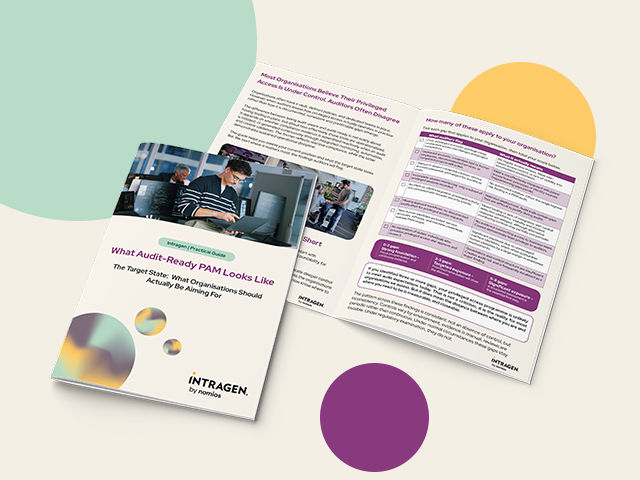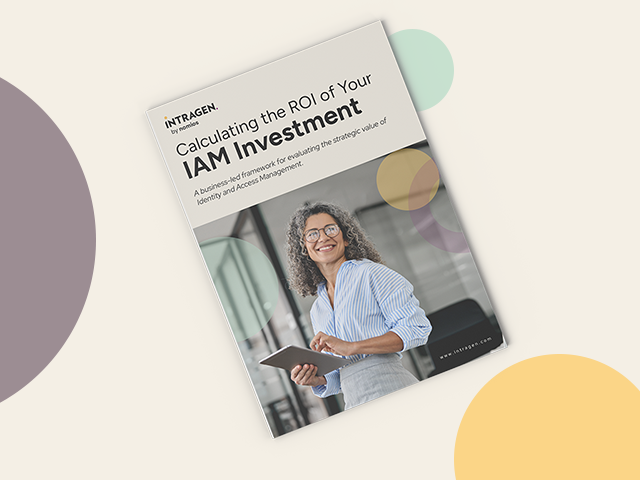
How CISOs, CFOs and programme leads justify identity investment and sequence the journey - from understanding the problem, to proving the ROI, to a prioritised, maturity-based roadmap.


A successful Identity and Access Management (IAM) programme starts with a clear business case and a sequenced roadmap, not a tool purchase. That means understanding what IAM covers, quantifying the risk it reduces and the value it returns, and honestly assessing where your organisation stands today versus where it needs to be. Intragen helps CISOs, CFOs and programme leads build that case - pairing an independent maturity assessment with ROI modelling and a prioritised, multi-year roadmap - so identity investment is defensible at board level and delivered in the right order.
IAM investment competes with every other security and IT priority, so it has to be justified in the language the board understands: risk reduced, compliance evidenced, and value returned.
Identity has become the control plane of the modern business, yet just 47% of UK businesses have two-factor authentication in place and only 30% monitor user activity (UK Government Cyber Security Breaches Survey 2025/2026) - which makes access control a board-level concern rather than an IT housekeeping task. But a list of tools is not a business case. Leaders need to connect identity spend to reduced breach exposure, faster audits, lower operational cost, and the ability to adopt cloud and AI safely. This page brings together the three things that turn a budget request into a defensible programme: understanding, ROI, and a maturity-based roadmap.
Talk to an identity specialistA credible IAM business case rests on three pillars: a clear understanding of scope, a quantified view of cost and return, and an honest assessment of current maturity against a target state.
Each has a supporting asset:
Together these answer the board’s real questions: what are we securing, what does it cost and return, and how do we get from here to there?
The ROI of IAM comes from three sources: the breach and downtime risk you avoid, the audit and administrative effort you save, and the business agility you gain by making access faster and safer.
Rather than a single headline number, a robust IAM ROI case models these over the life of the programme and weighs them against licensing, implementation and operational cost. Intragen’s ROI resource helps you frame that calculation for your own environment and stakeholders.
Calculate the ROI of your IAM investmentAn IAM Maturity Assessment gives you an independent, evidence-based picture of where your identity programme stands today and a prioritised plan for improving it - the foundation any roadmap needs.
Intragen’s assessment is a paid, specialist-led engagement (not a vendor pitch) spanning three domains: Identity Governance (IGA), Privileged Access Management (PAM) and Access Management (AM). It comes in two depths:
Both are led by workshops and stakeholder interviews, and the report is handed over in an interactive workshop where findings, priorities and next steps are agreed with your team - not simply emailed over.
Book an IAM Maturity AssessmentA good IAM roadmap sequences work by risk and dependency - securing the highest-risk access first and building the identity data foundations that everything else relies on - rather than deploying tools in isolation.
The maturity assessment produces the roadmap; the discipline is in the ordering. Typical early priorities are closing the most exposed gaps (incomplete offboarding, standing privileged access, unmanaged service accounts) and establishing clean joiner–mover–leaver processes, because faster automation on poor identity data simply accelerates poor decisions. From there the roadmap extends across the five disciplines the Beginner’s Guide describes:
Once the roadmap is set, the decision is how to deliver it - build and run IAM in-house, co-manage it, or outsource operation as a managed service - a choice driven by internal capacity, pace and total cost.
Many organisations need IAM outcomes faster than they can hire and retain specialist identity teams. Intragen supports every model, from advisory and consulting that shapes the strategy, through implementation and integration, to managed IAM services that operate the capability day to day. The right mix keeps the roadmap moving without the programme stalling on resourcing.
The fastest way to turn an IAM ambition into a funded, sequenced programme is to baseline where you are today.
If you are still framing the problem, start with the Beginner’s Guide to IAM. If you need the financial case, work through the IAM ROI resource. When you are ready to build the roadmap, an IAM Maturity Assessment gives you the independent baseline and prioritised plan to take to the board.
Speak to an identity specialistIAM investment competes with every other security and IT priority, so it must be justified in board language: risk reduced, compliance evidenced, and value returned. Just 47% of UK businesses have two-factor authentication in place and only 30% monitor user activity (UK Government Cyber Security Breaches Survey 2025/2026), making access control a board-level concern rather than IT housekeeping. A list of tools is not a business case.
A credible IAM business case rests on three things: a clear understanding of scope (what IAM covers), a quantified view of cost and return (ROI), and an honest assessment of current maturity against a target state. Together these show what you are securing, what it costs and returns, and how to get there.
IAM ROI comes from three sources: the breach and downtime risk you avoid, the audit and administrative effort you save, and the business agility you gain from faster, safer access. A robust case models these over the life of the programme and weighs them against licensing, implementation and operational cost.
An IAM Maturity Assessment is an independent, evidence-based review of where your identity programme stands today and a prioritised plan to improve it. Intragen's assessment spans Identity Governance, Privileged Access Management and Access Management, in a Light tier (around 4 weeks) or a Core tier (around 8 weeks) with a target-state roadmap.
A good IAM roadmap sequences work by risk and dependency, securing the highest-risk access first and building the identity data foundations everything else relies on, rather than deploying tools in isolation. Early priorities typically include closing exposed gaps like incomplete offboarding, standing privileged access and unmanaged service accounts.
The choice between building IAM in-house, co-managing it, or outsourcing it as a managed service is driven by internal capacity, pace and total cost. Many organisations need IAM outcomes faster than they can hire and retain specialist identity teams, so a managed or co-managed model keeps the roadmap moving.
Explore the assets that support your IAM business case and roadmap.