Privileged Access and Regulatory Compliance

Understand what regulators expect from privileged access controls, where audit gaps usually appear, and how to build evidence that stands up beyond a point-in-time review.

Man working on a laptop compliance

Define the problem

For regulated organisations, privileged access and compliance have become inseparable, and regulators are paying closer attention than ever.


When regulators assess cyber risk, they assess the effectiveness of controls. When they assess controls, they inevitably examine Privileged Access.


Because privileged accounts can override safeguards, access sensitive data, and make systemic changes. If those accounts are not governed consistently, the organisation’s risk posture is fundamentally weakened, regardless of how strong its policies appear.

Defining the security problem

For compliance teams, the question is no longer simply whether a PAM tool exists. The question is whether privileged access is consistently governed, monitored and evidenced across the organisation. You may have documented controls, run periodic access reviews, and implemented a Privileged Access Management solution, but the real test is this:

Can you demonstrate effective, continuous control over Privileged Access across your entire environment?

Increasingly, that is what regulators expect.

The shift from point-in-time audits to continuous assurance


Across regulated industries, the tone of regulatory oversight has changed. Audits are moving beyond policy design and sampling exercises and increasingly testing operational effectiveness. Regulators are examining whether privileged access controls are embedded, repeatable, consistent and capable of standing up to ongoing examination in day-to-day operations.


Audit readiness depends on more than having individual security controls in place. Organisations need to show that privileged access is understood, governed, monitored and evidenced consistently. This is where Privileged Access Management becomes a core part of a wider compliance and risk management strategy.


New regulations and internal control frameworks emphasise:

Accountability

Named ownership of privileged roles

Ongoing risk

Continuous oversight, not snapshots

Sustained evidence

Generated by operations, not assembled

Traceability

High-risk activity linked to individuals

This is no longer about producing documentation at audit time, it’s about demonstrating that privileged access compliance is continuously governed, monitored and evidenced across cloud, on-prem, and third-party environments. It also means being able to show that controls are applied consistently, exceptions are identified quickly, and high-risk activity can be traced back to named individuals and approved actions.

If that assurance is weak, findings can escalate quickly, board visibility increases, reputational risk follows, and in the event of a breach linked to privileged misuse, scrutiny intensifies further, particularly where organisations cannot demonstrate continuous oversight and effective privileged access governance.

Why strong controls break down in practice

In many environments, privileged access has evolved organically.


Legacy systems operate differently from cloud platforms, shadow IT introduces unmanaged accounts, operational teams prioritise availability and speed, and ownership between IT, security and compliance is not always clearly defined.


What organisations face is not an absence of control, but inconsistency.

IT Breakdown

Privileged access controls vary between environments, evidence gathering is remaining manual and time-consuming, access reviews are periodic rather than continuous, and monitoring is often incomplete. In large hybrid environments, maintaining PAM compliance consistently across systems becomes increasingly difficult without mature operational governance.

Under normal circumstances, these gaps may remain unnoticed. Under regulatory examination, they do not.

The most common mistake organisations make


Many organisations still treat PAM compliance as a technology implementation rather than an operational control discipline. A PAM tool can support compliance, but it does not create compliance on its own. Regulators and auditors increasingly look for evidence that privileged access controls are working in practice, not just documented in policy.


Deploying a tool, integrating key systems and running quarterly reviews can create the impression that compliance has been achieved. In practice, organisations often discover that this approach creates point-in-time comfort, not sustained assurance, particularly when controls are not consistently enforced across the wider environment.


Privileged access is not simply a tooling decision. It is an operational discipline that depends on governance, accountability and repeatable execution.


When compliance is treated as a one-off initiative, control maturity plateaus, processes drift, exceptions accumulate, and manual workarounds reappear, making it harder to sustain consistent control over time.


Audit preparation then becomes reactive, with teams assembling evidence rather than demonstrating embedded control. That is a fragile position to be in.


What good looks like in practice


Mature privileged access and compliance programmes share a recognisable set of characteristics. The focus should be on operational discipline, not features, because when privileged access governance is mature, the posture is noticeably different.


The hallmarks of a mature programme:

Capability What it looks like in practice
Centralised visibility Privileged identities known across every environment
Consistent enforcement Same policy applied to cloud, on-prem and third-party
Auditable provisioning Access granted and removed through defined processes
Session traceability Sessions linked to named individuals and approved actions
Embedded evidence Generated by operations, not recreated for auditors
Continuous governance Oversight in normal operations, not triggered by audits


Compliance becomes a by-product of disciplined operations. In these environments, audits are less disruptive, security questions can be answered confidently, and gaps are known and managed, not discovered under pressure. That allows organisations to respond to regulatory challenge with greater consistency and assurance.

A practical path forward


Strengthening privileged access governance does not require immediate transformation; it requires clarity. A structured assessment of your PAM maturity can help you determine:


  • Where privileged accounts exist
  • How consistently controls are applied
  • Whether monitoring and traceability are sufficient
  • How effectively you can evidence continuous control
  • Where ownership and governance need strengthening
A practical path forward

This creates a fact-based starting point from which organisations can prioritise improvements that strengthen governance, embed operational consistency, and extend control beyond technical coverage alone.


In regulated environments, sustained capability matters more than isolated projects, because regulators expect control to be demonstrable, repeatable, and maintained as part of business-as-usual operations. If your PAM approach depends on manual reviews, undocumented exceptions or controls that only work at audit time, it may be difficult to prove ongoing compliance. A PAM Quick Check helps you identify where privileged access is controlled in practice, where evidence is missing and what needs to improve next.

Natural next steps

Are you unsure whether your current privileged access controls would stand up to an audit tomorrow?
 
A PAM Quick Check helps identify high-risk accounts, evidence gaps and practical next steps for improving privileged access governance.

Privileged Access and Regulatory Compliance FAQs

PAM compliance is the ability to demonstrate that high-risk access (admin and superuser accounts) is controlled, monitored and auditable. It is not the same as owning a PAM tool. Regulators want evidence of consistent enforcement, traceable activity, and continuous governance, not a policy document and a quarterly review.

Most modern security and resilience regulations expect control over privileged access, even when they don't name PAM directly. The frameworks most often cited in Intragen engagements are:


  • NIS2 - Article 21 requires appropriate cybersecurity risk-management measures, including access control policies, asset management, incident handling and authentication. PAM helps evidence how privileged access is governed across these areas.
  • DORA - applicable from 17 January 2025, requires financial entities to continuously monitor and control ICT systems, manage ICT risk and maintain strong protective controls around access to critical systems. PAM supports this through privileged access governance, monitoring and evidence.
  • ISO 27001 and SOC 2 - both include privileged access as a core control area.
  • GDPR - requires demonstrable control over access to personal data.


Sector regulators routinely reference these frameworks in their own supervisory guidance.

IAM covers the whole workforce: who has access, to what, and whether that access matches their role. PAM focuses on a much smaller, much higher-risk group - the accounts that can override safeguards, change systems, or access sensitive data.


PAM compliance adds controls that go well beyond IAM: credential vaulting, session recording, just-in-time elevation, and approval workflows. Weaknesses in PAM are treated more seriously by auditors because the potential impact is greater.

Across regulated organisations, the same issues come up repeatedly:


  • Privileged accounts that sit outside the PAM solution, often on legacy or cloud systems.
  • Shared admin accounts that can't be traced to a named individual.
  • Controls applied inconsistently between cloud and on-premises environments.
  • Standing privileges granted in advance, rather than just-in-time elevation.
  • Manual, point-in-time access reviews that can't evidence continuous oversight.
  • Incomplete session monitoring, particularly for third parties and break-glass accounts.


Individually these are manageable. In combination, they usually signal that PAM has been treated as a tool, not a discipline.

Point-in-time compliance shows that controls were in place on the day of the audit. It relies on documentation, sampling and attestation. Continuous compliance shows that controls operate every day - evidence is generated by the system itself through session recordings, approval workflows, credential rotation logs and access reviews.


Regulators have shifted decisively toward the second model. The question is no longer whether controls existed at audit time, but whether they hold up under ongoing examination.

A PAM Quick Check assessment is a structured review of how privileged access is currently governed, controlled and evidenced. It is not a sales conversation, and it is not a tooling demo. Intragen's PAM Quick Check is a free, two-hour assessment with our specialists.


It evaluates privileged access maturity, identifies high-risk access paths, and produces a written report with prioritised next steps - regardless of whether you choose to work with us further.

Privileged Access Management Resources

Practical PAM Programme

How to build a practical privileged access programme

Most organisations approach PAM as a tool deployment. The ones who get it right treat it as an operating model. If your administrators have multiplied faster than your visibility, this is where to start.

640x480 - Audit-Ready - Brochure Image

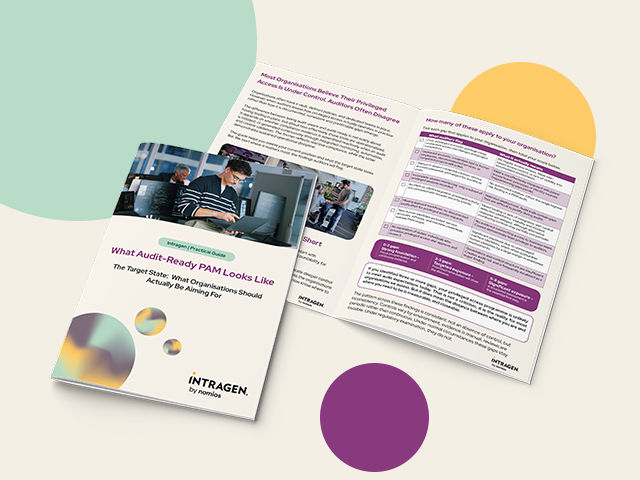
What Audit-Ready PAM Looks Like - A Practical Guide to PAM

Most organisations believe their privileged access is under control. Auditors often disagree. If you've ever wondered which category yours falls into this guide gives you a way to find out.

Manage machine credentials

How do you manage credentials for machine identities?

Service accounts, API keys, bots and automation scripts now outnumber your human users. When one of those keys leaks, it gives an attacker the same reach as a compromised admin, without the visibility.